The Killing Fields
*Published on **2018-09-25** by **Kelley @ traverse this earth** | Categories: Travel, solo travel*
—
While you’re traveling there are always days that stick out clearly in your mind. For me today was one of those days. My friend Pat flew in and fought against his jet lag to explore. After hearing about the tumultuous Cambodian history I learned that people could visit the places they happened. We hopped on down to Phnom Penh and went for it.
During the reign of terror that Pol Pot caused, millions of people’s lives were extinguished. Disease and starvation were used extensively to cause these deaths. But there was another dark side of this regime used as well. The forced migration of millions of people was a punishing move that can only be topped by the amount of torture they employed. The first sight that we visited was called The Killing Fields. Upon entry, you see a tall marble building. Later on we’ll learn why it’s there.

We took a right and followed the crowds. They weren’t heavy today, but enough to guide us. We walked in a loop that would lead us back to that building with a very different outlook.
The first part that we ran into was The Killing Fields Storage Room. Bullets were seen as too expensive to use on so many people so they used different weapons to kill victims instead.

Just seeing this picture made the whole situation so real. However, the best decision that we made to change the tour was to get the guided one. Instead of a person we were given headphones and a little black box. Otherwise, this may have just been an empty rectangle.

Instead we listened to the voice telling us about it being one of the many mass graves. During the reign of Pol Pot there were so many people killed, and thoughtlessly so, that instead of burying them in a humane manner, they were thrown into pits together.

A painting later in the tour brought us even closer to seeing it clearly with our minds eye.

People threw money in for the people who sill remained.

Visitors hung bracelets on the fence as a way of leaving their mark, that they had been here and witnessed this dark piece of history.

As we walked further on we were hit with another insane piece of reality. The first mass grave we saw was covered and protected. But the others were not. That meant that the rain would sometimes unearthed pieces of humans. Those are teeth sitting on a rock that have been collected after rains had uncovered them.

There were bits of clothing that washed to the surface.

You can see some here just surfacing.

They are collected here and kept to impress the humanness upon tourists passing through.

Pieces of bone were collected in the same way.

In 1980 there was an effort to exhume the bodies from their mass graves. However, 43 of the 129 graves were left untouched.

Unsettling signs were all over reminding us not to step on bone.

But through all of this, the part that got to me the most was The Killing Tree.

Not only were the children beaten but in the spirit of not wasting bullets as they used hanging, pickaxes or bamboo sticks on adults, they would just beat a child against a tree to kill them.

Covered in bracelets this tree is the site of massive horrors that still linger with us. On top of that unnerving fact the recording we listened to was the actual voice of the man who was doing the killings. He was put to trial and asked to speak to these murders. The sincere apology that came from him made my heart experience a monster as a man bent on saving his own life. It reminded me that many people took part in this and if they decided not to follow orders they would be extinguished themselves. Does this make it right? Of course not. But experiencing multiple voices in the telling of this story was intense in a way I hadn’t expected. Pat and I both found it a struggle to deal with, to think about or to imagine living through.

The uniform of the Khmer Rouge hung menacingly on display. I couldn’t imagine the fear and hatred brought on by the sight of these people.

I couldn’t imagine hearing them coming down the street.

The last thing we had to visit was the stupa. The big, glass-walled building we glanced at on the way in held a whole new meaning now.

Inside we were confronted with a gruesome photo of the graves still intact. Many people were murdered while blindfolded and still many were not. They were bound together with wire and assassinated.

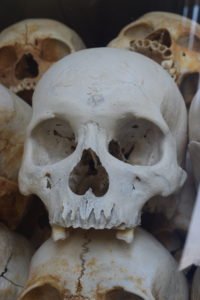
As if that were not heavy enough, this ominous stupa finally revealed itself. Inside were human skulls from the excavation in 1980.

And there was no small number of skulls.

Later I would read that there were almost 9000 human skulls in an attempt to reveal the massive nature of the killings here.

I imagine the parents, the spouses and partners, the children, the brothers and sisters stacked high upon one another. There was more evidence of wire used in the killings.

Last but not least in this disturbing journey, we noticed that the skulls had pieces missing.

And that on many of them there could be found a colored dot. Each of them denoted the way that that person was killed. It could be a pickax (those were much smaller holes) or a bamboo stick (bigger ones). The magnitude of all of these facts together left me breathless. I, along with many others, walked quietly almost through this entire experience.

That silence was deafening.
Leave a Reply